Chapter 7 of 10
Chapter 7: Essential Verbs & Conjugation Basics
Conjugate core verbs like いく, たべる, する, and くる in present/future and negative forms.
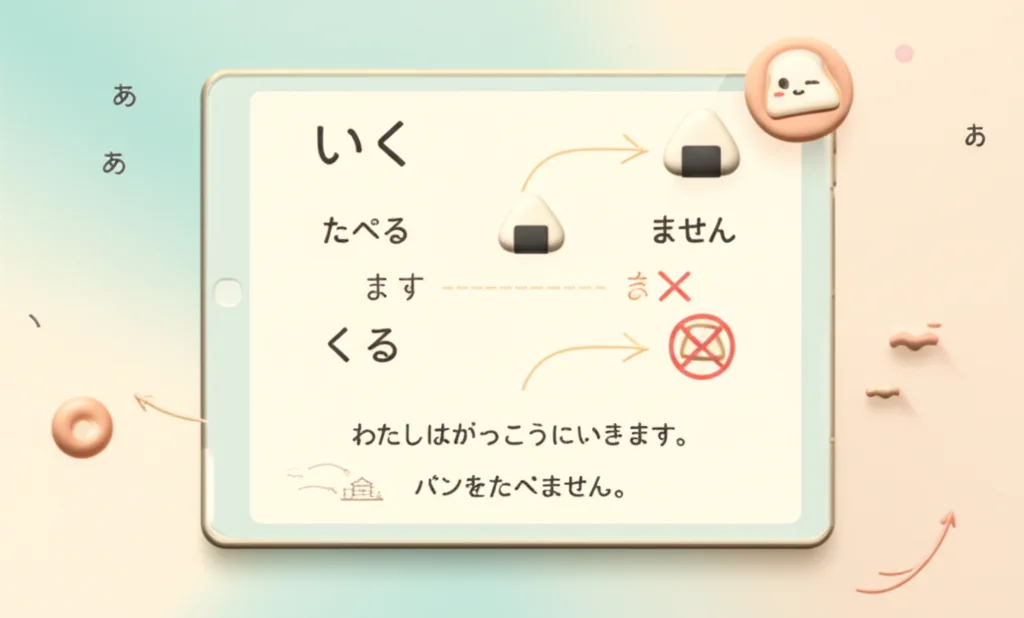
👋 Welcome to Chapter 7!
Ready to unlock more conversational power in Japanese? Verbs are the action words that make sentences move, and in this chapter, you'll learn four essential verbs and how to use them in their polite present/future and negative forms. Let's get moving! 🚀
🌟 Essential Verbs
These four verbs are fundamental for everyday Japanese conversation. Master them, and you'll be able to express a lot!
1. いく (iku) - To Go
This verb is used for physical movement from one place to another.
いく (iku) - to go
Pronunciation: "ee-koo" (like the "ee" in "feet", and "koo" in "cool")
Example: がっこうにいく (gakkou ni iku) - to go to school
2. たべる (taberu) - To Eat
As simple as it sounds, this verb lets you talk about food! 🍣
たべる (taberu) - to eat
Pronunciation: "tah-beh-roo" (like "tah" in "father", "beh" in "bed", "roo" in "rooster")
Example: パンをたべる (pan o taberu) - to eat bread
3. する (suru) - To Do
This is an incredibly versatile verb, often combined with nouns to create new verbs!
する (suru) - to do
Pronunciation: "soo-roo" (like "soo" in "soup", "roo" in "rooster")
Example: しゅくだいをする (shukudai o suru) - to do homework
4. くる (kuru) - To Come
The counterpart to "to go," this verb indicates movement towards the speaker's location.
くる (kuru) - to come
Pronunciation: "koo-roo" (like "koo" in "cool", "roo" in "rooster")
Example: ともだちがくる (tomodachi ga kuru) - a friend comes
📝 Conjugation Basics: Polite Forms
Japanese verbs change their endings based on tense, politeness, and more. For now, let's focus on the polite present/future and negative forms, which are standard for beginners.
Polite Present/Future Affirmative: ~ます (~masu)
To make a verb polite and express present or future action (like "I go," "I will eat," "They do"), you attach ~ます (~masu) to its stem.
いく (iku) ➡️ いきます (ikimasu) - go/will go
たべる (taberu) ➡️ たべます (tabemasu) - eat/will eat
する (suru) ➡️ します (shimasu) - do/will do
くる (kuru) ➡️ きます (kimasu) - come/will come
Polite Present/Future Negative: ~ません (~masen)
To make a verb polite and express negative present or future action (like "I don't go," "I won't eat"), you attach ~ません (~masen) to its stem.
いく (iku) ➡️ いきません (ikimasen) - don't go/won't go
たべる (taberu) ➡️ たべません (tabemasen) - don't eat/won't eat
する (suru) ➡️ しません (shimasen) - don't do/won't do
くる (kuru) ➡️ きません (kimasen) - don't come/won't come
💬 Basic Sentence Drills
Now let's put these verbs into action with some simple sentences!
Example 1: I go to school.
わたしはがっこうにいきます。
わたし (watashi) - I
は (wa) - topic particle
がっこう (gakkou) - school
に (ni) - destination/direction particle
いきます (ikimasu) - go/will go
Translation: I go to school.
Example 2: I don't eat bread.
パンをたべません。
パン (pan) - bread
を (o) - object particle
たべません (tabemasen) - don't eat/won't eat
Translation: I don't eat bread.
Example 3: I do homework.
しゅくだいをします。
しゅくだい (shukudai) - homework
を (o) - object particle
します (shimasu) - do/will do
Translation: I do homework.
Example 4: My friend will come.
ともだちがきます。
ともだち (tomodachi) - friend
が (ga) - subject particle (often used with くる/kuru)
きます (kimasu) - come/will come
Translation: My friend will come.
🎯 Practice Time!
Let's test your understanding. Try to translate these sentences or fill in the blanks. Then, tap "Reveal Answer" to check!
Question 1: How do you say "to eat" (polite present/future)?
たべます (tabemasu)
Question 2: Translate: "I don't go."
いきません。 (ikimasen)
Question 3: Fill in the blank: "I will do homework."
わたしは しゅくだいを ______。
します (shimasu)
Complete sentence: わたしはしゅくだいをします。
Question 4: Translate: "I don't eat ramen."
ラーメンをたべません。 (rāmen o tabemasen)
🌸 Cultural Note: Politeness in Verbs
The ~ます (~masu) and ~ません (~masen) forms you just learned are called polite forms (丁寧語 - teineigo). These are the standard forms used in most everyday conversations with people you don't know well, or when you want to show respect. As you progress, you'll learn other verb forms, but these polite forms are your essential starting point for speaking Japanese appropriately in most situations. Always a good choice! 👍
🎉 Chapter 7 Summary
- You've learned four vital verbs:
- いく (iku) - to go
- たべる (taberu) - to eat
- する (suru) - to do
- くる (kuru) - to come
- You now know how to conjugate verbs into their polite present/future affirmative form using ~ます (~masu).
- You can also form the polite present/future negative using ~ません (~masen).
- You practiced basic sentences combining these verbs with particles like は (wa), を (o), に (ni), and が (ga).
Great job! Keep practicing these verbs and their conjugations. They are building blocks for so much more. Ganbatte! 💪
Chapter quiz
Japanese Chapter 7 Quiz: Essential Verbs & Conjugation Basics
10 questions
- 1
What does いく mean?
- 2
What does たべる mean?
- 3
What does する mean?
- 4
What does くる mean?
- 5
What does わたしはがっこうにいきます mean?
- 6
Form the Japanese sentence "I eat bread"
Tap tiles in order to build the answer - 7
What does パンをたべません mean?
- 8
What is the polite form of いく (to go)?
- 9
Form the Japanese sentence "I don't go to school"
Tap tiles in order to build the answer - 10
What is the negative form of たべる (to eat)?
You know the lesson. Now practice speaking it.
Continue in Native Talk with story scenes and conversation battles built for natural Japanese.