Chapter 5 of 10
Chapter 5: Simple Sentence Structure
Understand Japanese word order (SOV), particles を and が, and the question marker か.
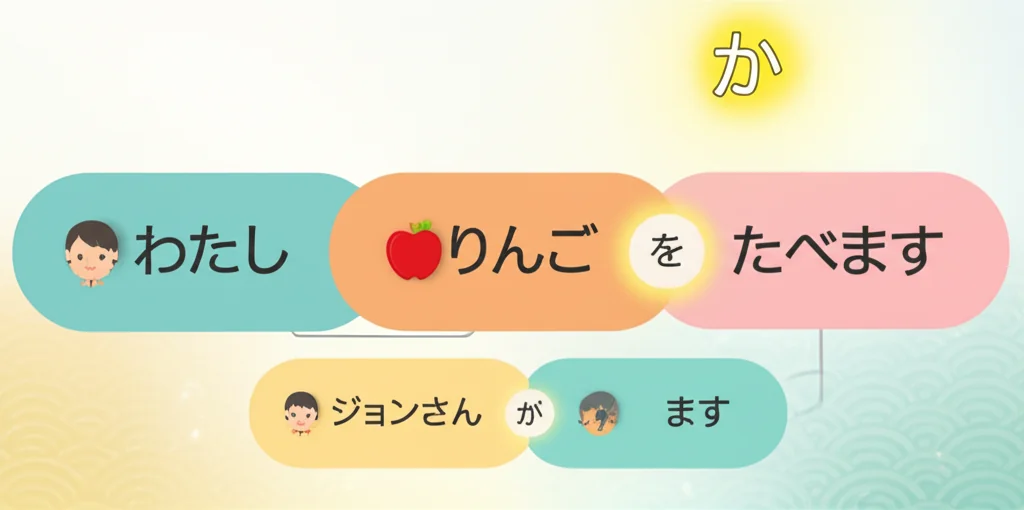
🎉 Let's Build Sentences!
Welcome back, language explorer! In this chapter, we're diving into the absolute basics of building simple sentences in Japanese. Get ready to put words together and express yourself!
Don't worry, it's simpler than you might think. Japanese has a very consistent structure once you get the hang of it.
🇯🇵 Japanese Word Order: SOV
The first big difference from English? Japanese has a different word order! English typically uses Subject-Verb-Object (SVO): "I eat apples."
But Japanese uses Subject–Object–Verb (SOV). The verb always comes at the end of the sentence!
わたしはりんごをたべます。
Watashi wa ringo o tabemasu.
I (Subject) apples (Object) eat (Verb).
See? "I" (subject) comes first, then "apples" (object), and finally "eat" (verb). It's like saying "I apples eat."
This SOV order is fundamental, so keep practicing it!
💫 Particles: The Sentence Glue
Particles are super important in Japanese. They are small words that attach to other words to show their grammatical function (like subject, object, topic, etc.). Think of them as tiny, powerful labels!
を (o): The Object Marker
The particle を (pronounced "o," never "wo" in modern Japanese) marks the direct object of a verb. It tells you "what" is being verbed!
ジュースをのみます。
Jūsu o nomimasu.
(I) drink juice.
パンをかいます。
Pan o kaimasu.
(I) buy bread.
Notice how the object always comes BEFORE the verb, and を links them.
が (ga): The Subject Focus Marker
While は (wa) marks the general topic of a sentence (which we learned in Chapter 4), が (ga) specifically marks the subject when it's being introduced or emphasized, especially in questions and when identifying who or what is doing the action.
Think of が as pointing directly at the subject, saying "THIS is who/what is doing it!"
ジョンさんがきます。
Jon-san ga kimasu.
John is coming. (Focus on John as the one who is coming)
ねこがいます。
Neko ga imasu.
There is a cat. (Focus on the existence of a cat)
💡 Cultural Note: The distinction between は and が can be tricky and takes time. For now, remember は introduces a topic, while が identifies the specific subject of a verb, especially when you're answering a "who/what" question!
❓ Question Marker: か (ka)
Asking questions in Japanese is super easy! Just add the particle か (ka) to the end of a sentence. No need to change the word order or raise your tone at the end (though you often will in speech!).
それはほんですか?
Sore wa hon desu ka?
Is that a book?
りんごをたべますか?
Ringo o tabemasu ka?
Do you eat apples? / Will you eat apples?
Simple, right? Just pop か on the end!
✍️ Practice Time!
Choose the correct particle for each sentence.
1. わたし [ ] みず [ ] のみます。
(I drink water.)
2. だれ [ ] きましたか?
(Who came?)
3. コーヒー [ ] かいますか?
(Will you buy coffee?)
🌟 Chapter 5 Summary
- Japanese sentence structure is Subject–Object–Verb (SOV). The verb always comes last!
- The particle を (o) marks the direct object of a verb. (What is being verbed?)
- The particle が (ga) marks the subject, especially when introducing or emphasizing who or what is performing the action.
- Add か (ka) to the end of a sentence to turn it into a question.
You've just learned the building blocks for countless Japanese sentences. Keep practicing combining words with these powerful particles!
Chapter quiz
Japanese Chapter 5 Quiz: Simple Sentence Structure
10 questions
- 1
What is the basic word order in Japanese?
- 2
What particle is used to mark the direct object in Japanese?
- 3
What particle is used to mark the subject with focus in Japanese?
- 4
What does わたしはりんごをたべます mean?
- 5
What does ジョンさんがきます mean?
- 6
Form the Japanese sentence "I eat bread"
Tap tiles in order to build the answer - 7
What is the question marker in Japanese?
- 8
Form the Japanese question "Do you eat rice?"
Tap tiles in order to build the answer - 9
What is the difference between は and が particles?
- 10
Form the Japanese sentence "I read a book"
Tap tiles in order to build the answer
You know the lesson. Now practice speaking it.
Continue in Native Talk with story scenes and conversation battles built for natural Japanese.