Chapter 10 of 10
Chapter 10: Your First Japanese Paragraph
Combine grammar and vocabulary to write about your routine in connected Japanese sentences.
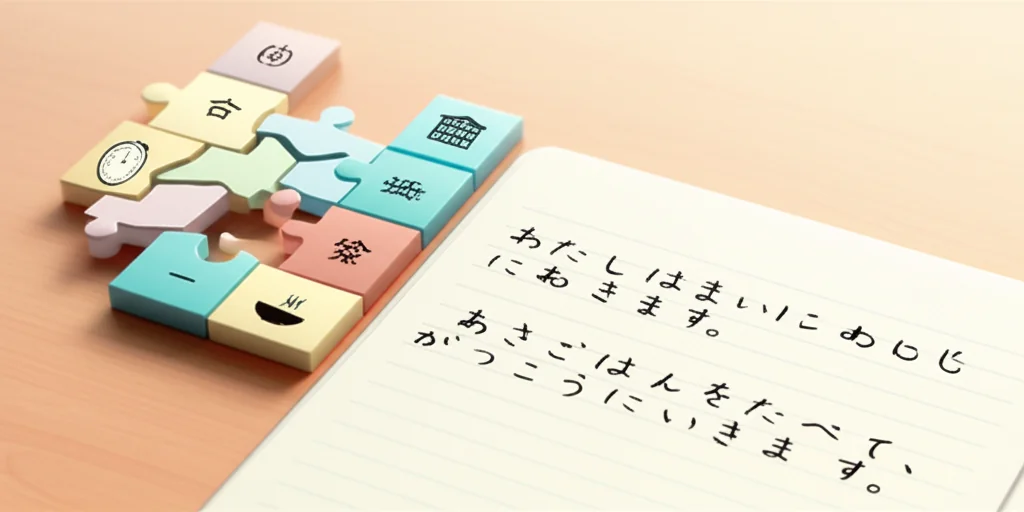
🌟 Welcome to Paragraph Power!
Hey there, language adventurer! 👋 You've made it to Chapter 10, and trust us, this is a big one. For weeks, you've been learning individual words, perfecting particles, and mastering verb conjugations.
Today, we're putting it all together! You're going to write your very first Japanese paragraph. How cool is that?! 😎
It's time to tell a mini-story about your day or your family using all the amazing Japanese you've learned so far.
🔗 Connecting Ideas: The て-form Review
To write a paragraph, we need to connect sentences smoothly. Remember the て-form? It's your best friend for listing actions in a sequence!
あさごはんをたべます。[Asagohan o tabemasu.]
I eat breakfast.
がっこうにいきます。[Gakkou ni ikimasu.]
I go to school.
➡️ Combine them:
[Asagohan o tabete,]
Eating breakfast, (and then)...
[Gakkou ni ikimasu.]
I eat breakfast and go to school.
The comma (、) after the て-form shows that the action continues or leads to the next one. You can chain multiple て-forms before ending with a politeness marker like ます/です.
✍️ Building Your Routine Paragraph
Let's start by describing a typical day. Think about your morning routine!
Step 1: Start with "I" and "Every Day"
Who is doing the action? You! And when does it happen? Every day!
[Watashi wa mainichi roku-ji ni okimasu.]
I wake up at 6 o'clock every day.
Remember: まいにち [mainichi] (every day) and ~じに [-ji ni] (at ~ o'clock).
Step 2: Add Your Morning Actions (using て-form)
What do you do right after waking up? Let's add eating breakfast and going to school!
[Asagohan o tabete,]
eating breakfast,
[Gakkou ni ikimasu.]
I go to school.
Combined:
[Watashi wa mainichi roku-ji ni okite, asagohan o tabete, gakkou ni ikimasu.]
I wake up at 6 every day, eat breakfast, and go to school.
See how the て-form of おきます [okimasu] (to wake up) is おきて [okite] ?
Step 3: Continue Your Day
What happens next? Maybe you study, then go home, eat dinner, and sleep!
[Gakkou de benkyou shite,]
at school, I study,
[Uchi ni kaerimasu.]
and return home.
[Yorugohan o tabete, nemasu.]
I eat dinner and sleep.
Putting It All Together: Your First Paragraph!
Here's a full example of a daily routine paragraph:
I wake up at 6 every day, eat breakfast, and go to school. At school, I study, and return home. I eat dinner and sleep.
Isn't that amazing? You just read a Japanese paragraph you can actually understand!
👨👩👧👦 Talking About Family
You can also use what you've learned to talk about your family's routine or activities!
Remember ~と [-to] (with/and) to connect people.
[Chichi wa shichi-ji ni okimasu.]
My father wakes up at 7.
[Haha wa terebi o mite, souji o shimasu.]
My mother watches TV and cleans.
[Watashi wa tomodachi to eiga o mimasu.]
I watch a movie with my friend.
You can combine these with て-form too!
[Chichi wa hataraite, yoru kaerimasu.]
My father works and returns at night.
💡 Cultural Note: The Importance of Routine
Daily routines in Japan, especially for students and salarymen/women, are often very structured and punctual. Waking up early, having a set schedule for meals, study, and work, and commuting are common aspects of daily life. The sentences you're learning today are very practical for describing a typical Japanese day!
📝 Let's Practice!
Practice 1: Fill in the Blanks
Complete the routine. Use the Japanese words given below.
- Words: おきます (wake up), たべて (eat - て-form), いきます (go), します (do), ねます (sleep)
わたしは まいにち 7じに 。
、がっこうに 。
うちで べんきょうを 。
よるごはんを たべて、。
(Hint: Focus on the て-form for connecting actions!)Practice 2: Translate to Japanese
Translate these simple sentences into Japanese. Try to use て-form where appropriate!
1. I read a book and drink coffee.
(Hint: よみます → よんで)2. My mother cooks and cleans.
(Hint: りょうりします → りょうりして)3. I wake up at 7:30 every day and go to work.
(Hint: 7時半 [shichiji han], おきます → おきて)🎉 You've Come So Far!
Give yourself a huge pat on the back! You started with basic greetings and now you're crafting whole paragraphs in Japanese. That's incredible progress!
This chapter is a milestone. It shows you're not just learning words, but truly building sentences and expressing more complex ideas.
Keep practicing your daily routines and family activities. The more you use these patterns, the more natural they'll become!
素晴らしいです! (Subarashii desu! - That's wonderful!)
Chapter quiz
Japanese Chapter 10 Quiz: Your First Japanese Paragraph
10 questions
- 1
What does わたしはまいにち6じにおきます mean?
- 2
What does あさごはんをたべて、がっこうにいきます mean?
- 3
What does まいにち mean?
- 4
What does あさごはん mean?
- 5
What particle is used to connect two actions in Japanese?
- 6
Form the Japanese sentence "I wake up at 7 and eat breakfast"
Tap tiles in order to build the answer - 7
What does かぞく mean?
- 8
What does わたしのかぞくは4にんです mean?
- 9
Form the Japanese sentence "I study Japanese and go to school"
Tap tiles in order to build the answer - 10
What is the purpose of Chapter 10?
You know the lesson. Now practice speaking it.
Continue in Native Talk with story scenes and conversation battles built for natural Japanese.